
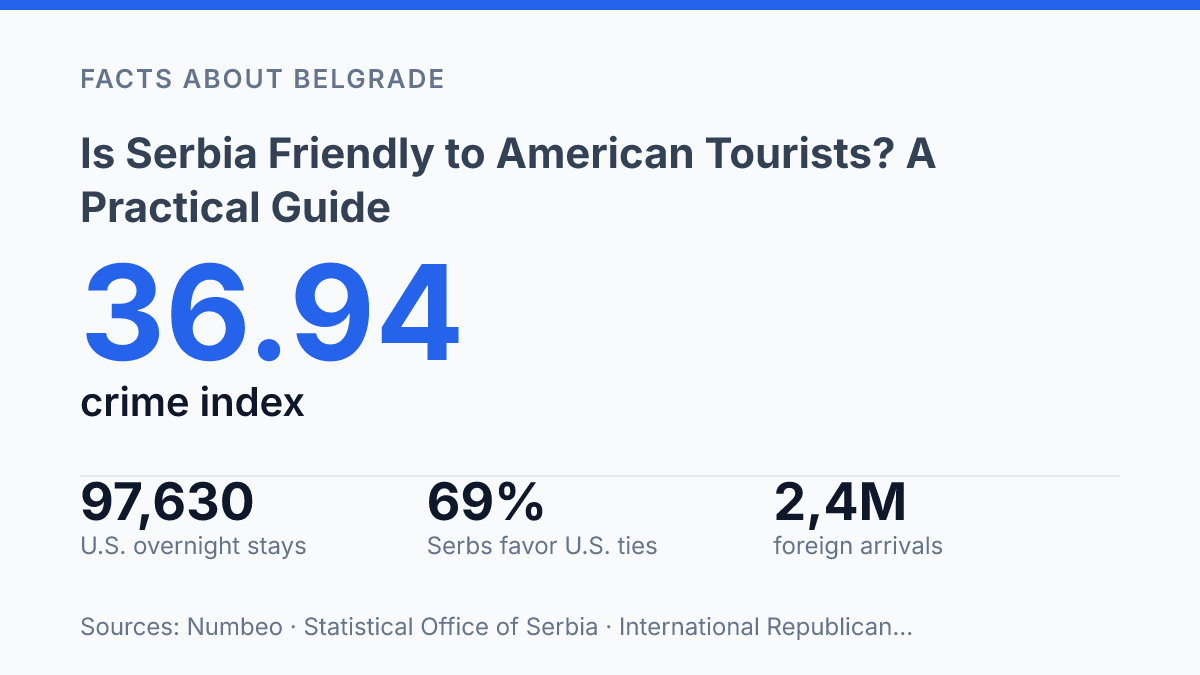
The question “Is Serbia friendly to American tourists?” has a more evidence-based answer than stereotypes suggest: in a 2026 International Republican Institute survey, 69% of Serbian adults said strong relations with the United States are important. Tourism data points in the same direction, with 31,877 U.S. arrivals recorded from January to July 2026, a 9.7% increase from the same period in 2025.
That does not mean every interaction is warm or every risk is minor, but it does place American visitors within a country that is used to foreign travelers and increasingly receives them from the United States. The practical picture depends on context: Belgrade and Novi Sad are easier for English speakers, petty theft is the main official safety concern, and local expectations around registration, manners, and transport can shape how smooth a trip feels.
How American visitors are usually received
69% of 1,502 Serbian adults said strong relations with the United States are important in polling conducted by the International Republican Institute from May 27–June 24, 2026. That figure does not mean every conversation will be politically neutral, but it does undercut the idea that American visitors should expect routine hostility simply because they are from the United States.
Safety, scams, and common tourist concerns
The official U.S. advisory treats Serbia less as a violent-crime concern than as a place where inattentive visitors can lose wallets, bags, or money through ordinary city scams. The U.S. Department of State advisory for Serbia, issued on August 27, 2026, is Level 2: Exercise increased caution due to crime, and it identifies most crimes against foreigners as opportunity crimes such as pickpocketing and purse-snatching. That framing matters because it points toward practical urban precautions rather than a need to avoid normal tourist movement.
Language, manners, and useful local customs
Serbia’s urban English level is high enough that many routine tourist interactions can be completed without Serbian, especially with younger people and front-line hospitality staff. The EF English Proficiency Index ranked Serbia 25th globally in its 2024/2025 results, and the capital’s central districts tend to be easier for English-speaking visitors than smaller towns or rural areas.
This does not mean English is universal. At bus stations, municipal offices, neighborhood bakeries, markets, or family-run businesses away from tourist routes, communication may depend on gestures, translation apps, or a few Serbian basics such as “dobar dan” for good day and “hvala” for thank you.
Greetings are usually simple but matter more than elaborate phrasing. A handshake is commonly preferred at a first meeting, in businesslike settings, or when being introduced to older adults, while closer friends and relatives may greet each other more warmly.
In shops, restaurants, and apartment buildings, a brief greeting on arrival and a polite farewell on leaving can make an interaction feel less abrupt. Serbian conversational style can also be more direct than some Americans expect; short answers or frank opinions are not necessarily intended as rudeness.
Invitations for coffee, a meal, or a family dinner should be treated as social commitments rather than casual filler. Arriving reasonably on time, accepting at least a small amount of what is offered when possible, and thanking the host clearly are safer cues than trying to over-interpret local rules. A small gift such as sweets, wine, or flowers can be appropriate for a home visit, though expectations vary by household and occasion.
Practical etiquette is generally moderate rather than rigid. In restaurants and cafés, rounding up the bill or leaving about 10 percent for good service is common, with cash tips often preferred even when paying by card.
In churches and monasteries, modest clothing is expected: covered shoulders, no beachwear, and restrained behavior inside are more important than formal dress. These customs are not tests of cultural perfection, but observing them signals respect and reduces the small frictions that can otherwise make a visitor stand out unnecessarily.
What Americans should know before planning a trip
For many Americans, the trip-planning detail most likely to disrupt a Serbia itinerary is not reception by locals but whether entry paperwork, payment access, and cash habits have been checked before departure. U.S. passport holders do not need a tourist visa for stays of 90 days or less, according to the U.S. Department of State.
The same guidance notes that foreigners are expected to register with local police within 24 hours of arrival, a step usually handled by hotels but worth confirming for apartment stays or private accommodation. Travelers carrying more than €10,000 in cash must declare it on entry or exit, which matters for anyone combining Serbia with a longer regional trip.
Money planning is more local than many first-time visitors expect. Serbia uses the Serbian dinar, not the euro, and everyday pricing is normally in dinars even where euros are familiar to people working in tourism.
Payment cards are widely accepted in hotels, larger restaurants, supermarkets, and many businesses in Belgrade and Novi Sad, but cash remains useful for smaller cafés, markets, taxis, rural guesthouses, and stops outside major centers. This does not make travel difficult, but it changes the practical rhythm of a trip: keeping a modest amount of local currency can prevent small purchases from becoming inconvenient.
A first itinerary is often simplest when built around Belgrade, Novi Sad, and one or two short excursions rather than an overextended cross-country route. Belgrade works well as the main arrival base because it concentrates museums, restaurants, nightlife, riverfront areas, and onward transport connections.
Novi Sad is a common second stop, often paired with Petrovaradin Fortress or the Fruška Gora wine and monastery area. Other day-trip choices depend on interests and season, but visitors commonly consider places such as Topola and Oplenac for royal history, Sremski Karlovci for wine and architecture, or Niš for Roman and Ottoman-era sites if the schedule allows a longer transfer.
The main planning conclusion is practical rather than cultural. Serbia is generally straightforward for American tourists to navigate, especially on a city-focused route, but entry compliance, dinar-based spending, and realistic travel distances deserve attention before the trip is set.
The Practical Difference Between Welcome and Preparedness
The Practical Difference Between Welcome and Preparedness
Serbia is best understood as a destination where personal reception and travel discipline are separate issues. Positive attitudes toward U.S. ties and rising American arrivals suggest that nationality alone is unlikely to create problems for most visitors, especially in major cities.
The less visible factors are more likely to affect the trip: police registration through accommodation, cash declaration rules, taxi pricing, pickpocketing in crowded places, and road safety outside the main tourist areas. A sensible next step is to plan Serbia as a normal European trip with a few local compliance checks, rather than as a place requiring either special caution or special reassurance.
Frequently Asked Questions
Q: Is Serbia safe and welcoming for American tourists?
A: Serbia is generally considered welcoming to foreign visitors, including Americans, especially in major cities and tourist areas. As in any destination, normal precautions around transport, nightlife, and belongings remain sensible. Public attitudes are usually shaped more by personal interaction than nationality.
Q: Do Americans need a visa to visit Serbia?
A: For short tourist stays, U.S. passport holders can usually enter Serbia without a visa for up to 90 days within a 180-day period. Entry rules can change, so passport validity and current border requirements should be checked before travel. Proof of onward travel or accommodation may also be requested in some cases.
Q: Will language be a problem for American visitors in Serbia?
A: English is commonly spoken in hotels, restaurants, and other tourist-facing businesses in larger cities. Outside those settings, communication can be less reliable, particularly in smaller towns or with older generations. A translation app and a few basic Serbian phrases can make routine interactions easier.
Q: How do Serbians generally feel about Americans?
A: Attitudes toward Americans are varied and are influenced by history, politics, and personal experience. In everyday travel settings, most interactions are practical and courteous rather than political. Respectful behavior and interest in local customs usually matter more than nationality.
Q: What should American tourists know before traveling to Serbia?
A: Cash is still useful in some places, although cards are widely accepted in cities and larger businesses. Taxis should be booked through official services or reputable apps where possible, and travelers should confirm fares before longer rides. Basic awareness of local customs, transport options, and entry rules helps avoid common misunderstandings.