
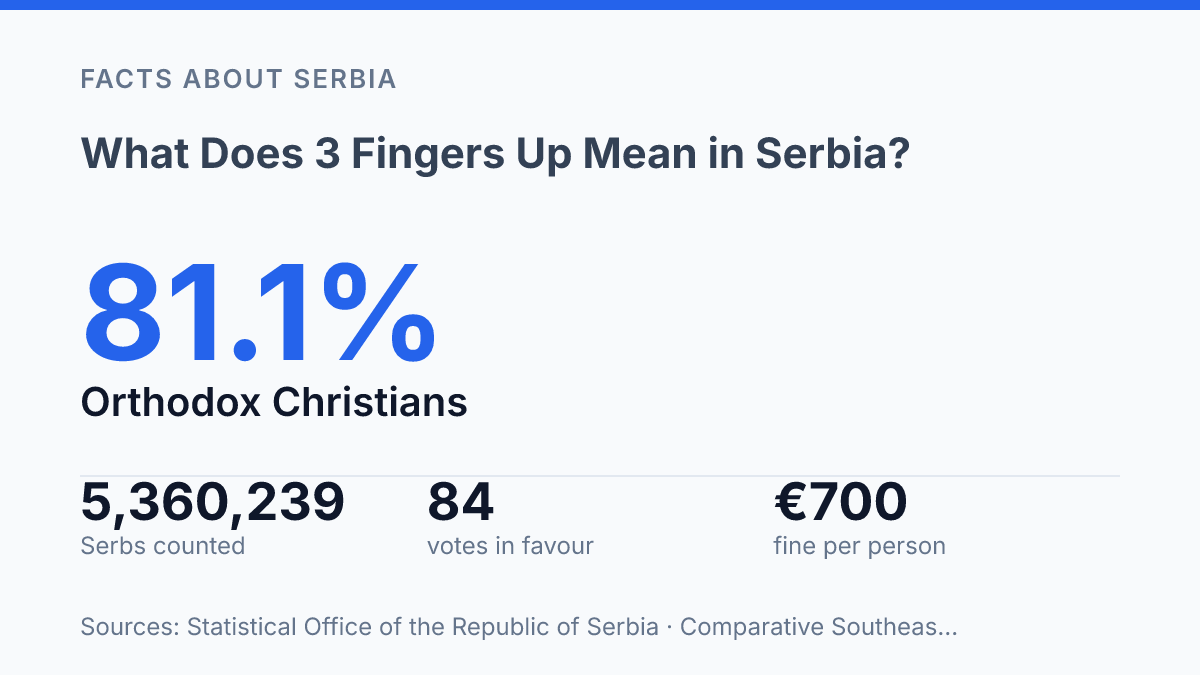
“What does 3 fingers up mean in Serbia?” has a different answer at a church celebration, a football match, and a Kosovo memorial site, especially in a country where Orthodox Christians made up 81.1% of residents in the 2022 census. The gesture is commonly read through the Holy Trinity and Serbian national identity, but its modern public form also passed through mass politics: MONDO traces its popularization to the 9 March 1991 Belgrade demonstrations, while Vuk Drašković linked his use of three separated fingers to both the Trinity and the 1815 Takovo uprising.
That dual history explains why the sign can look ordinary in one setting and confrontational in another. The article separates the gesture’s cultural base from its political charge, then shows how context, location, audience, and recent conflict memory change its meaning.
The hand sign’s main meaning in Serbian culture
The same three raised fingers that can accompany crossing oneself in an Orthodox church can also appear over a packed stadium as a national signal. In its religious form, the gesture is tied to the Serbian Orthodox Church and the Orthodox sign of the cross, where the thumb, index finger, and middle finger are brought together to symbolize the Holy Trinity. The religious reference remains widely legible because Serbia’s 2022 census recorded 5,387,426 Orthodox Christians, or 81.1% of the population, according to the Statistical Office of the Republic of Serbia.
In public life, the raised three fingers also operate as a marker of Serbian identity. They are commonly seen at political rallies, among sports crowds, during national celebrations, and in patriotic commemorations, where the meaning is less about a liturgical act and more about belonging, solidarity, or national pride. This is why the sign is recognizable even outside explicitly religious settings: it draws on Orthodox symbolism while functioning as a broader cultural emblem.
Context separates these meanings more than the hand shape alone. Inside a church, during prayer, or while making the sign of the cross, the three joined fingers are best read as devotional symbolism.
At a football match, campaign event, public march, or flag-filled celebration, three raised fingers are more likely to be read as a Serbian identity signal, and sometimes as nationalist expression depending on the setting. The gesture is therefore not a universal Serbian greeting or a neutral hand wave; it is a context-dependent sign whose interpretation changes with place, occasion, and audience.
Why the gesture became politically charged
The gesture acquired much of its modern political weight during the breakup of Yugoslavia, when signs of ethnic belonging became public markers in conflict, protest, and state-building. The 1990s brought a sharp rise in Serbian nationalism as Yugoslavia fragmented, and symbols that had older religious or cultural associations were drawn into rallies, military imagery, and media coverage. Danas described the modern salute as a visual expression of Serbian “awakening, unity and strength,” while also noting its wartime and nationalist associations and its return from front lines to Serbian streets and rallies by the late 1990s.
Accounts of its modern popularisation are not fully uniform, which is why a single settled origin story is difficult to defend. MONDO reported that the salute was popularised during the 9 March 1991 Belgrade demonstrations, while Vuk Drašković said he had raised three separated fingers in early 1990 and linked the gesture to religious symbolism and Serbian historical imagery. The important point for interpretation is less the first documented use than the conditions in which the sign became widely visible: a period when identity symbols were being read through competing national projects and wartime memory.
Public use by high-profile figures and supporters has kept those political associations active. A 2025 academic article in Comparative Southeast European Studies noted that Serbia’s president Aleksandar Vučić raised the salute after the UN General Assembly adopted the Srebrenica memorial resolution on 23 May 2024, a vote that passed with 84 votes in favour, 19 against, and 68 abstentions. In sport, Football NSW recorded that Zoran Petkovic received a two-month concurrent suspension after making the gesture during a 2022 Waratah Cup semi-final, showing how disciplinary bodies outside the Balkans may interpret it as more than cultural expression.
This does not mean every use signals extremism or hostility. Many Serbs may understand the raised three fingers as ordinary patriotism, ethnic identity, or a familiar communal sign. Outside Serbia, however, the same gesture is often filtered through memories of the Balkan wars, Srebrenica, Kosovo, and nationalist mobilisation, so it can be read as a political statement even when the user frames it as faith-based or patriotic.
How to read the gesture in different settings
A hand sign that may pass without comment at a wedding can attract official attention at Gazimestan, where Tanjug reported that a Pristina basic court fined 36 Serbs €700 each after a June 28 detention linked to chanting and the traditional salute. The difference is not the fingers alone, but the setting, accompanying words, and political sensitivity of the place. A memorial site connected to contested national history carries a different interpretive weight from a family photograph or a church courtyard.
In religious services, the gesture is usually read through devotional practice and communal custom rather than party politics. At baptisms, weddings, saint-day gatherings, or family celebrations, raised fingers may appear alongside crosses, icons, formal dress, or ordinary group photos, which tends to make the meaning cultural or religious. At concerts and public celebrations, it can also function as a broad identity marker, especially when used with singing, national colors, or collective cheering rather than directed at an opposing group.
Sports settings require closer reading because celebration and provocation can look similar in a crowded stadium. A player or supporter raising three fingers after a goal, while wearing club colors and facing fellow fans, may be making a celebratory Serbian identity gesture. The same sign aimed at rival supporters, paired with hostile chanting, nationalist banners, or symbols tied to conflict, is more likely to be read as confrontational or as a declaration of political allegiance.
Protest imagery and official ceremonies are generally more charged because gestures in those spaces are designed to be seen and recorded. Kosovo Online reported in 2025 that Kosovo police said a Serbian high-school graduate in North Mitrovica had “provoked” people by showing the salute and was given a verbal warning, illustrating how local political conditions can change the stakes of an everyday act. In demonstrations, commemorations, border areas, or diplomatic settings, body orientation, slogans, clothing, flags, insignia, and the identity of the audience all help determine whether the sign is benign, assertive, or deliberately provocative.
Common mistakes outsiders make
The easiest error is to treat every raised three-finger pose as the same sign, even though similar shapes can carry unrelated meanings in other countries. In some places, three raised fingers simply mean the number three; in Scouting, a three-finger sign has its own promise-related symbolism; in other political cultures, comparable gestures have been adopted for causes with no Serbian connection. The physical similarity can be misleading because meaning depends on which fingers are raised, whether the palm faces outward, whether the fingers are joined or spread, and who is making the gesture to whom.
Gesture translation creates false certainty because hand signs do not behave like universal vocabulary. A shape that looks familiar in one cultural setting may be read through a different historical, religious, or political code in another.
This is especially true in photographs and short video clips, where sound, sequence, audience reaction, and the wider event are often removed. A cropped image can make a family pose, a crowd celebration, or a confrontational signal appear more similar than it would have seemed to people present at the time.
Another common mistake is to assume that intent can be inferred from the hand alone. The Serbian three-finger sign may be used with pride, ritual familiarity, irony, defiance, or provocation, and those meanings are not visually separable without surrounding evidence.
Hostility is more plausible when the gesture is paired with aggressive chanting, threatening conduct, targeted display toward a rival group, or other symbols that narrow its meaning. Without those cues, a claim that the gesture is necessarily hostile is often stronger than the evidence supports.
The risk of misreading is highest when context is stripped away and the sign is interpreted through an outsider’s closest available comparison. A useful distinction is between recognition and conclusion: it may be possible to recognize the gesture as Serbian-coded while still withholding judgment about motive. That distinction prevents two opposite errors, either treating the sign as harmless in every setting or treating it as inherently aggressive in every appearance.
Why context now carries the meaning
The three-finger sign is unlikely to settle into one neutral meaning because its audiences do not share the same historical reference points. In Serbia, census data helps explain why a Trinitarian and national reading remains widely legible; in Kosovo, Srebrenica memory, diplomatic disputes, and public-order rules can make the same raised hand appear as a political statement.
Cases from North Mitrovica, Gazimestan, the UN, and an Australian football tribunal show that interpretation now travels with the gesture. The practical consequence is simple but narrow: the sign is safest to read not as a universal Serbian greeting, but as a context-dependent symbol whose meaning is set by place, timing, and company.
Frequently Asked Questions
Q: What does raising three fingers mean in Serbia?
A: In Serbia, the three-finger gesture is commonly associated with Serbian identity, especially national and religious symbolism. It is often linked to the Orthodox Christian Trinity and has also been used in patriotic contexts. Its meaning can vary by setting, so the gesture is not interpreted the same way everywhere.
Q: Is the three-finger salute offensive in Serbia?
A: The gesture is not inherently offensive in Serbia and is often seen positively in nationalist or cultural settings. In some neighboring countries, however, it can be viewed as provocative because of its political associations. Context matters, and the same gesture may communicate pride in one place and hostility in another.
Q: Why do Serbian athletes use the three fingers sign?
A: Serbian athletes often use the gesture to signal national pride after victories or during public appearances. It functions as a visible cultural marker rather than a literal message. Because of its strong association with Serbian identity, it is commonly used in sports celebrations and team photos.
Q: Does the three-finger gesture have a religious meaning?
A: Yes, it is often connected to the Orthodox Christian Trinity, with the three fingers symbolizing the Father, Son, and Holy Spirit. That religious interpretation has helped shape the gesture’s wider cultural significance in Serbia. In practice, the gesture can carry both religious and national meanings at the same time.
Q: Can the meaning of the three fingers sign change by country?
A: Yes, the interpretation can change significantly depending on where it is used. In Serbia it is usually read as a sign of identity or solidarity, while elsewhere it may be understood as political or confrontational. The social and historical context determines how the gesture is received.