
Does Serbia allow LGBTQ? The legal answer is yes for consensual same-sex relations and anti-discrimination protection, but no for marriage recognition. The practical answer is more qualified. The U.S. Department of State’s 2026 guidance says Serbia has no legal restrictions on LGBTQ-related events, information, services, or consensual same-sex relations, while the country remains under a Level 2 travel advisory to exercise increased caution.
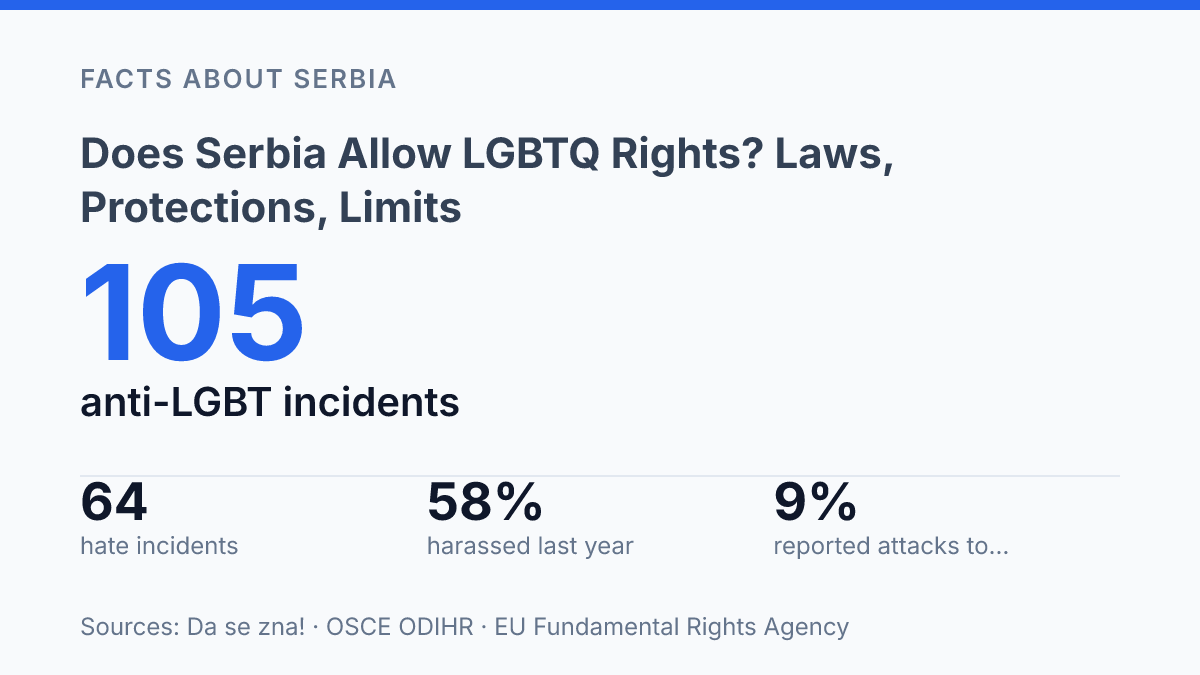
Serbian equality law also provides fines for certain forms of discrimination based on sexual orientation, yet the constitution has defined marriage as a union of a man and a woman since November 8, 2006. That split between formal legality and social exposure shapes the real position of LGBTQ people in Serbia. Civil-society monitors recorded 105 homophobia- and transphobia-motivated incidents in 2024, making enforcement, reporting, Pride security, and day-to-day safety central to understanding what the law permits and what public life may still constrain.
What the law says about LGBTQ people in Serbia
Serbian law can punish discrimination based on sexual orientation or gender identity, yet the same legal system still treats marriage as an opposite-sex institution. The core statute is the Law on the Prohibition of Discrimination, first adopted in 2009 and later amended, which bars unequal treatment across protected grounds that include sexual orientation and gender identity. Its protections are not only declaratory: official equality guidance describes fines of 50,000–500,000 Serbian dinars for a legal entity or entrepreneur that requires a person to disclose sexual orientation, prevents its expression, or discriminates on that basis, with lower fines for responsible or natural persons.
The 2021 amendments strengthened the anti-discrimination framework by updating protected grounds and clarifying forms of unlawful treatment. In legal terms, this means LGBTQ people are not outside the protection of Serbian civil law simply because of sexual orientation or gender identity. A current advisory from the U.S. Department of State rates Serbia at Level 2, Exercise Increased Caution, while also stating that there are no legal restrictions on consensual same-sex sexual relations, LGBTQ-related information or services, or events focused on sexual orientation.
Family law is more limited. Serbia’s constitutional and civil-law framework does not recognize same-sex marriage, and marriage is legally framed as a union between a man and a woman. Proposed legislation on same-sex unions has been discussed, but the absence of enacted recognition means same-sex couples do not receive the same automatic family-law status as married different-sex couples.
The result is a split legal position: LGBTQ status and conduct are lawful, and discrimination is formally prohibited, but full relationship recognition is not available. Protection from unequal treatment can support access to work, services, and public life, while the lack of marriage or equivalent partnership rights leaves gaps in areas such as family status, inheritance planning, and legal recognition of a couple’s shared life.
How police, courts, and public institutions handle cases
Only 9% of LGBTIQ respondents in Serbia who experienced physical or sexual attacks said they reported them to police, according to the EU Fundamental Rights Agency’s 2024 Serbia factsheet. That figure is central to enforcement: formal protections depend not only on statutes, but on whether victims trust institutions enough to report abuse and whether authorities record bias motivation consistently once a report is made.
Several public bodies can receive or act on complaints, but their mandates differ. The Commissioner for Protection of Equality handles discrimination complaints and can issue opinions, recommendations, and public warnings, making it the main equality body for civil anti-discrimination matters.
The Protector of Citizens, Serbia’s Ombudsman, can examine allegations of maladministration by public authorities, including complaints connected to police conduct or institutional inaction. The Ministry of Interior is the key law-enforcement body for receiving reports, protecting public order, and investigating incidents that may later be referred to prosecutors.
Available data indicate that civil-society monitoring captures a wider pattern of hostility than official systems show. Da Se Zna! recorded 105 homophobia- or transphobia-motivated incidents in 2024, its highest annual total since monitoring began.
OSCE/ODIHR’s hate-crime reporting for Serbia for the same year listed 64 reported hate incidents and noted that a significant share targeted the LGBTI community; ODIHR also stated that several incidents allegedly involved on-duty police officers and that around half of anti-LGBTI incidents were serious physical assaults. These sources do not measure the same universe of cases, but together they point to a gap between lived experience, police reporting, and cases that reach formal processing.
European monitoring has identified the same structural weakness. In its 2025 Serbia report, the European Commission noted that Serbia still lacked centralized official hate-crime data disaggregated by bias motivation, which limits public assessment of how police, prosecutors, and courts handle anti-LGBTQ incidents from complaint to outcome.
The Commission also reported that, as of August 2025, the equality commissioner’s office had 45 employees out of 60 planned posts. Institutional channels therefore exist, but underreporting, capacity limits, and incomplete official data make enforcement uneven and harder to evaluate in practice.
Public life, Pride events, and safety concerns
Belgrade has moved from banning Pride marches for consecutive years to hosting EuroPride 2022, but large LGBTQ public events still depend heavily on police planning, route controls, and last-minute risk assessments. Belgrade Pride is now a recurring public event, which marks a clear change from the period when authorities treated marches as too dangerous to permit. That visibility should not be read as full social acceptance, because organizers continue to plan around hostile counter-mobilization, threats, and the possibility of violence.
The earlier pattern explains why Pride in Serbia is often discussed through security as much as through rights. Belgrade’s first Pride in 2001 was broken up by violent attacks, and the 2010 parade was followed by major clashes involving anti-Pride groups and police.
Authorities then banned Pride marches from 2011 to 2013, citing public-order and security risks. Since 2014, Pride events have generally been able to take place in Belgrade, but often with a visible police cordon, controlled access, and restrictions designed to separate participants from opponents.
EuroPride in Belgrade showed the same tension at a larger scale. International human-rights groups, including Amnesty International and Human Rights Watch, criticized Serbian authorities in 2022 after the Interior Ministry moved to ban the planned march route, with officials citing security threats. The march eventually went ahead on a shortened route under heavy police protection, while counter-protests and arrests around the event reinforced the point that legal permission did not remove safety risks.
Current event guidance reflects that cautious environment. In 2026, Belgrade Pride advised participants to enter through four designated access points, expect police and private-security checks, avoid carrying prohibited items, travel in larger groups, remove Pride-identifying items when leaving, and call 192 if they felt unsafe. Such instructions are practical safety measures, but they also show that public LGBTQ visibility is treated as something requiring active risk management.
Survey evidence points to wider pressures beyond Pride week. The EU Fundamental Rights Agency’s 2024 Serbia factsheet reported that 58% of LGBTIQ respondents said they had experienced harassment in the previous year, while 17% said they had been physically or sexually attacked in the previous five years. Those figures help explain why public events can be lawful and increasingly visible while many people still assess ordinary public expression, affection, or advocacy through a safety lens.
What travelers and residents should expect
A same-sex couple can usually book one hotel room in Belgrade without breaking any rule, but the same couple may still be treated as legal strangers at a hospital desk, rental office, or administrative counter. In hotels, the practical issue is often documentation rather than sexuality: foreign guests are normally asked for passports or national ID, and accommodation providers commonly handle tourist registration with the authorities, usually within 24 hours. Couples staying in private accommodation should confirm that the host completes any required registration, and names on reservations, insurance documents, and emergency contacts should match identity documents to reduce avoidable questions during checks.
Public behavior calls for more context-sensitive judgment than the formal rules suggest. Holding hands or checking into shared accommodation is more likely to pass without comment in central Belgrade or Novi Sad than in smaller towns, late-night settings, or politically charged public gatherings.
Open affection may attract stares, verbal abuse, or unwanted attention even where no official restriction applies, so many residents calibrate visibility by location, time of day, and company. That pattern does not mean LGBTQ people must remain invisible; it means daily comfort can vary sharply between private social spaces, major-city venues, and more exposed public settings.
For support, Belgrade-based Labris is one of Serbia’s established lesbian human rights organizations, while Da Se Zna! is also based in Belgrade and is known for documenting anti-LGBTQ incidents and directing people toward reporting and assistance options. These organizations can be useful for information, referrals, and community contacts, especially for residents or longer-stay visitors trying to understand local procedures. In urgent situations, emergency services, trusted local contacts, hotel staff, or consular officials may be more appropriate first points of contact, depending on the circumstances.
Serbia also differs from some nearby EU member states on relationship recognition. Croatia has a life-partnership system for same-sex couples, while Slovenia has permitted same-sex marriage and joint adoption since 2022.
Serbia’s position is therefore not simply a question of whether LGBTQ people can live, travel, socialize, or organize there; many can and do. The sharper limit is that a same-sex relationship may have little formal weight when institutions ask who counts as a spouse, family member, or next of kin, and treatment may vary by institution and locality rather than following a consistently supportive practice.
The gap between legal permission and daily risk
Serbia’s position is best understood as legal permission without full legal equality or consistent practical safety. That distinction matters because future change is likely to depend less on whether LGBTQ identity is allowed in principle and more on whether institutions can make existing protections credible.
Centralized hate-crime data, clearer police accountability, and movement on the pending same-sex union framework would change how residents and visitors assess risk. Until then, the safest reading is cautious rather than categorical: public LGBTQ life exists, Pride takes place, and discrimination is prohibited, but visibility can still require planning that would be unnecessary in countries where legal protection and social safety align more closely.
Frequently Asked Questions
Q: Is being LGBTQ legal in Serbia?
A: Yes. Same-sex relations are legal in Serbia, and discrimination on the basis of sexual orientation is prohibited in several areas of public life. Legal status, however, does not mean full equality in practice, because family rights and recognition remain limited.
Q: Does Serbia recognize same-sex marriage?
A: No. Serbia does not legally recognize same-sex marriage, and same-sex couples also do not have the same family law rights as opposite-sex couples. This affects matters such as inheritance, parental recognition, and access to spousal protections.
Q: Are there anti-discrimination protections for LGBTQ people in Serbia?
A: Yes. Serbian law includes protections against discrimination in employment, education, and access to services. Enforcement can vary, but the legal framework gives LGBTQ people a basis for complaints when unequal treatment occurs.
Q: Can LGBTQ people openly hold public events in Serbia?
A: Public events such as Pride marches have been held in Serbia, but they have also faced security concerns and political resistance. The ability to gather publicly exists in law, while the practical environment can depend on local conditions and police protection.
Q: What are the main limits on LGBTQ rights in Serbia?
A: The main limits are family recognition and uneven social acceptance. Same-sex partnerships are not fully recognized, and protections against harassment or unequal treatment are not always applied consistently. This creates a gap between formal legal rights and everyday experience.