
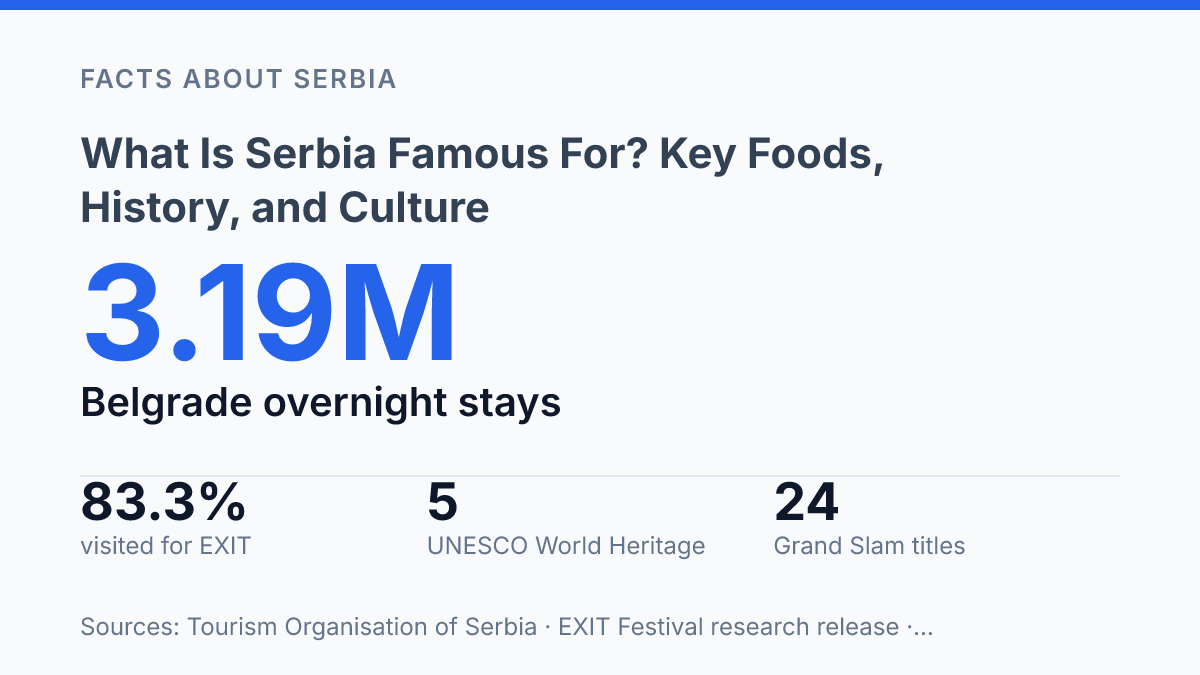
The answer to “What is Serbia famous for?” starts with Belgrade’s 3,193,823 foreign-tourist overnight stays in 2024, but Serbia’s reputation is not built on the capital alone. Novi Sad drew 580,673 overnight stays the same year, while UNESCO records 5 World Heritage properties in the country, from medieval monasteries to Gamzigrad-Romuliana and stećci tombstone graveyards.
Serbia is also recognised through less expected markers: a plum spirit placed on UNESCO’s intangible heritage list in 2022, a cuisine ranked 12th in the TasteAtlas Awards 2025/26, and athletes such as Novak Djokovic and Nikola Jokić who made a small country highly visible in global sport. These layers explain why Serbia is remembered as both a Balkan crossroads and a country with unusually concentrated cultural signals.
Belgrade, Novi Sad, and the country’s best-known sights
Belgrade alone recorded 3,193,823 foreign-tourist overnight stays in 2024, which helps explain why Serbia’s international image often begins in the capital rather than in its smaller historic towns, according to Tourism Organisation of Serbia data published in 2025. Its most recognisable landmark is Kalemegdan Fortress, a fortified complex and park set above the meeting point of the Sava and Danube rivers. That position is not just scenic: the confluence made the site strategically valuable for centuries and gives modern Belgrade one of its clearest symbols of layered rule, conflict, and urban continuity.
Across the Danube corridor, Novi Sad adds a different kind of visibility. The city recorded 239,031 tourist arrivals and 580,673 overnight stays in 2024, according to the Statistical Office of the Republic of Serbia, confirming its role as more than a secondary stop after the capital. Petrovaradin Fortress is central to that identity, both as a historic riverfront stronghold and as the setting for the EXIT festival, whose organisers reported that the 2024 edition contributed €23.7 million to Novi Sad and Serbia and that 83.3% of surveyed visitors came to the city solely for the event.
Serbia’s best-known sights are not limited to urban fortresses. UNESCO lists 5 World Heritage properties in Serbia and 12 sites on the country’s Tentative List as of 2026, giving international recognition to heritage that reaches well beyond Belgrade and Novi Sad. Studenica Monastery is one of the clearest examples: a medieval Orthodox monastic complex associated with the Nemanjić dynasty and valued for its architecture, frescoes, and role in Serbian religious history.
This contrast matters because the country’s reputation rests on both riverfront cities and inland medieval heritage. Kalemegdan and Petrovaradin present Serbia through strategic geography and public cultural life, while Studenica represents an older religious and dynastic memory. Together, these places give a concrete answer to Serbia’s fame that is broader than a capital-city checklist.
Cuisine and drinks that shaped Serbia’s reputation
A TasteAtlas Awards 2025/26 score of 4.45 placed Serbian cuisine 12th among the platform’s “100 Best Cuisines in the World,” reflecting how strongly everyday dishes shape the country’s public image. That reputation is not built around a single national plate. It comes from foods that are widely understood across the Balkans, then adapted through Serbian grilling habits, household preserves, dairy spreads, and strong fruit spirits.
Ćevapi and pljeskavica are the best-known grilled meat examples, though neither belongs only to Serbia. Ćevapi, small minced-meat sausages, and pljeskavica, a large seasoned patty, are eaten across several former Yugoslav countries, which makes them part of a broader Balkan food culture. In Serbian practice, their association with kafanas, grill stands, family gatherings, onions, flatbread, and kajmak gives them a recognisable local setting rather than a wholly exclusive origin story.
Ajvar, kajmak, and rakija carry a more domestic form of recognition because they are closely tied to hospitality. Ajvar, the roasted pepper relish prepared for winter stores, appears with grilled meats, bread, and cheese.
Kajmak, a rich dairy product somewhere between clotted cream and fresh cheese, is strongly linked with central and western Serbian meals. Rakija is often served to guests as a gesture of welcome, and its cultural role reaches beyond alcohol into family production, seasonal fruit harvests, and celebration.
The clearest Serbian drink marker is plum rakija, especially šljivovica. On 1 December 2022, the preparation and use of traditional plum spirit šljivovica was inscribed on UNESCO’s Representative List of the Intangible Cultural Heritage of Humanity, formalising a practice long associated with rural households and ceremonial occasions. Šumadija, together with other plum-growing regions, is central to that identity because plum orchards support both home distilling traditions and commercial production.
Food also intersects with tourism because the country’s most visited urban centres concentrate restaurants, markets, and tasting experiences. In 2024, foreign tourists recorded 3,193,823 overnight stays in Belgrade, an 8% increase on 2023, making it the top Serbian destination for international visitors by overnight stays, according to the Tourism Organisation of Serbia. That visitor volume helps explain why grilled meats, rakija, ajvar, and kajmak often become the most immediate culinary reference points for outsiders encountering Serbian culture.
Music, sport, and public figures people recognise
A single athlete has made Serbia’s flag visible at more Grand Slam trophy ceremonies than any other man in tennis history. According to the ATP, Novak Djokovic is the men’s all-time Grand Slam leader with 24 singles titles, a record that makes him Serbia’s most recognisable modern sports figure in many countries. His prominence matters because tennis is an individual, highly televised sport, so national association is unusually direct: the player’s name, language, celebrations, and Davis Cup appearances all reinforce Serbia’s visibility without requiring wider knowledge of the country’s teams or leagues.
Basketball has also widened that recognition, especially through Nikola Jokić, who was named NBA Most Valuable Player for the third time in 2024. The NBA noted that this placed him among only nine players with three or more MVP awards, a category that gives Serbian sport a second contemporary global reference point beyond tennis. Even so, international sporting fame is concentrated around a small number of elite figures, which can make the country appear more defined by exceptional individuals than by its broader sporting culture.
Nikola Tesla remains the best-known Serbian-born scientific figure, although his identity is historically more layered than a simple national label suggests. He was born in Smiljan, then part of the Austrian Empire, into a Serb family, and built most of his professional career in the United States. That combination explains why he is claimed in several historical and cultural narratives, while still occupying a central place in Serbian public memory through institutions, monuments, and everyday references.
EXIT Festival gives Serbia a different kind of cultural visibility because it links the country to contemporary European music rather than only heritage or biography. Founded in 2000 as a student-led event, it grew into one of Europe’s major festival brands, with programming that has included electronic music, rock, hip-hop, and pop for international audiences. Its reputation helps position Novi Sad as a place associated with youth culture and live music, not only with architecture or regional history.
These globally recognisable names and events can overshadow slower-moving traditions such as folk singing, epic poetry, literary culture, and local music scenes. The imbalance is not unusual: international audiences often remember countries through a few exportable symbols first. In Serbia’s case, those symbols are unusually varied, spanning elite sport, electrical invention, and large-scale music programming.
Why Serbia is remembered in the Balkans
Serbia’s regional memory reaches back to a medieval state that made monasteries, royal patronage, and church independence lasting markers of identity. Under the Nemanjić dynasty, the Serbian kingdom expanded its political authority while supporting Orthodox religious life through endowments, manuscript culture, fresco painting, and monastic foundations.
The creation of an autocephalous Serbian Orthodox Church in 1219, associated with Saint Sava, gave that heritage an institutional form that outlived the medieval state itself. This helps explain why Serbia is often remembered not only through cities or famous individuals, but through a long religious and artistic continuity visible across its historic sacred sites.
Geography also shapes Serbia’s reputation because the country sits between Central Europe and the wider Balkan peninsula rather than fitting neatly into only one cultural zone. The Danube corridor, the Pannonian Plain, and the Morava valley have connected north-south and east-west movement for centuries, bringing overlapping influences in architecture, foodways, music, language, and everyday customs. As a result, Serbia can appear Central European in some urban and historical contexts while remaining strongly Balkan in its social traditions, Orthodox heritage, and shared regional cuisine.
This layered identity is why Serbia’s public image varies by audience. For some, the country is primarily associated with medieval Orthodox culture and historic landmarks; for others, it is recognised through strong flavours, family hospitality, athletes, musicians, scientists, and large public events.
Those impressions are not separate reputations so much as different entry points into the same cultural profile: a country remembered through old religious institutions, strategic geography, communal food and drink, and highly visible modern personalities. The balance between historical continuity and contemporary pop-culture recognition depends on where the observer first encounters Serbia, but both help explain its distinct place in the Balkans.
What Serbia’s reputation reveals about the Balkans
Serbia’s international reputation is strongest when it is treated less as a checklist than as a record of overlapping influences. The same country can be read through Roman imperial remains, Orthodox monasteries, Ottoman-era food habits, Yugoslav memory, electronic music tourism, and modern athletes whose careers unfold far outside the Balkans. That range makes simple national branding difficult, but it also gives Serbia a durable advantage: different visitors arrive with different reference points and still find a recognisable connection.
The practical consequence is clear for tourism and culture policy. Better transport links, careful heritage protection, and credible regional storytelling will shape whether Serbia is seen mainly through a few famous names or as one of the Balkans’ most layered cultural destinations.
Frequently Asked Questions
Q: What foods is Serbia best known for?
A: Serbian cuisine is known for grilled meats, pastries, and hearty dishes shaped by Balkan, Ottoman, and Central European influences. Common examples include ćevapi, pljeskavica, sarma, and burek. Fresh bread, dairy, and plum-based products also play a major role in everyday eating.
Q: What historical landmarks in Serbia attract the most attention?
A: Belgrade Fortress is one of the country’s best-known historic sites because it reflects centuries of strategic importance at the meeting point of major empires. Many visitors also look to monasteries, Ottoman-era streets, and Austro-Hungarian architecture for a broader view of the country’s past. These places show how Serbia’s history has been shaped by repeated cultural overlap.
Q: Why is Serbia important in Balkan history?
A: Serbia has often been central to political and military events in the Balkans because of its location between Central Europe and the eastern Mediterranean. The region’s medieval states, Ottoman rule, and 20th-century conflicts all left lasting marks on national identity. That history helps explain why memory, religion, and statehood remain prominent themes in Serbian public life.
Q: What cultural traditions is Serbia known for?
A: Serbia is known for strong family customs, Orthodox Christian traditions, and celebrations such as Slava, the family patron saint day. Folk music, traditional dance, and hospitality are also widely associated with social life. These customs remain visible in both rural settings and larger cities, which helps keep them culturally relevant.
Q: What are Serbia’s most famous natural attractions?
A: Serbia is known for river gorges, mountain areas, and protected parks that support hiking, rafting, and wildlife viewing. Đerdap National Park, Tara National Park, and the Uvac canyon are among the most recognized examples. These sites matter because they show that the country’s appeal is not only historical and cultural, but also environmental.