
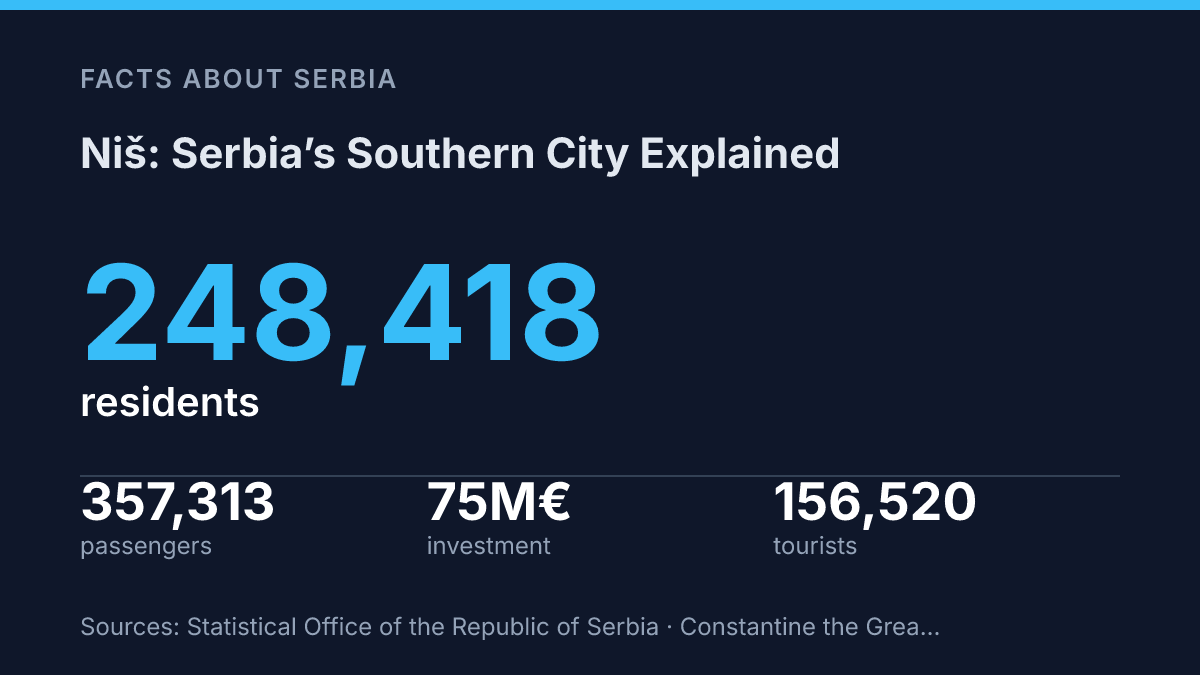
Niš looks small beside Belgrade, but its city territory held 248,418 residents across 71 settlements in 2024. That gap between the compact centre and the wider municipality is the first thing to get right.
This is not just a southern stop on the way somewhere else. The road from Belgrade splits here toward Thessaloniki and Athens on one side, Sofia and Istanbul on the other. The city also serves a catchment of about 1 million people across southern and eastern Serbia. In my honest opinion, that’s why treating it as a footnote to the capital gets the country wrong.
Even the name asks for care. GeoNames lists forms from Nis and Nish to Ниш, plus the airport code INI. This guide sets the city in its real geography, explains why it matters, and clears up the naming details before the deeper reading begins.
Where Niš sits in Serbia
Niš is in southern Serbia, but its map position is less edge than hinge: key routes toward Bulgaria and North Macedonia meet near it. That matters more than distance from Belgrade.
The city can feel peripheral on a national map. The same southern location gives it weight in travel, freight, and regional politics.
The city sits in the Nišava valley, where movement naturally funnels between central Serbia and the wider Balkans. For travelers, that means it works as a practical stop between north-south and east-west journeys. For trade, it gives the area a role that a simple population ranking doesn’t fully explain.
Scale changes the picture too. According to the Statistical Office of the Republic of Serbia / DevInfo, the city territory covers 596 km², includes 71 settlements, had 248,418 mid-year residents in 2024. A density of 417 people per km².
So the urban core is only part of the story. The administrative area reaches into a wider local network.
2011 census data placed the city among Serbia’s major urban centers, with a population of 183,164 in the city proper. That figure helps separate the compact city from the broader municipal territory. In my view, this distinction matters because otherwise people underestimate how much southern Serbia depends on this one center.
The Nišava District names Niš as its administrative center, which gives the city a formal role beyond everyday commuting and commerce. Its southern identity isn’t just about geography. It shapes how the city connects Serbia to neighboring regions, and how people in the south see their place within the country.
Why this city matters beyond Belgrade
Belgrade, Novi Sad, and Niš form Serbia’s top tier by size, not a capital-plus-everywhere-else story. That rank matters because the southern city is the third largest city in Serbia. It gives the country a second major pole outside the Belgrade–Novi Sad axis.
For southern Serbia, it serves as the main center for administration, services, and transport. Ministries and agencies may pull attention toward the capital, but daily regional life needs a nearer hub. This city fills that role for courts, hospitals, universities, business services, logistics, and onward travel.
The scale is bigger than its national profile suggests. The city government describes it as one of six functional macroregional centres in Serbia, with a southern and eastern Serbian catchment of about 1 million people. In my honest opinion, that figure matters more than any postcard image, because it shows who depends on the city when paperwork, specialist care, education, or connections can’t wait.
Transport tells the same story, though not in a neat success-line narrative. Constantine the Great Airport handled 357,313 passengers in 2024, down 20% from the previous year, yet cargo rose to 424,579 kg, a 510% jump, according to the airport’s statistics page.
Passenger visibility slipped. Freight demand surged.
That contrast explains the city’s real position. It has less national visibility than the capital. It carries far more regional responsibility than its profile suggests.
Smaller cities orbit it. The south would feel thinner without it.
Name variants and how people write it
A single accent mark can decide whether a search result sends you to a Serbian bus timetable or leaves you staring at a blank field. Niš is sometimes spelled Nish in English, especially where keyboards, booking systems, or older databases avoid diacritics.
That plain spelling is useful. If you’re searching airline routes, hotel listings, or English-language travel forums, try it when the Serbian form doesn’t return much. But don’t mistake the simplified version for the form you’ll see most on local signs.
The letter š represents the English sound in words like “sh.” So the city name sounds close to “neesh,” not “niss.” That one sound shift matters if you’re asking for directions, buying tickets, or listening for announcements.
Maps, travel sites, and older English texts may use different spellings for the same city. GeoNames, accessed in 2026, lists 12 alternate forms and codes, including INI, Nich, Nis, Nisch, Nish, the Serbian Latin form. The Cyrillic Ниш.
That doesn’t mean these are equal in normal use. It means search systems have learned to catch variants.
In my humble opinion, the smartest approach is to recognize both the local spelling and the plain-English workaround. Use the simplified form when a website won’t accept special characters. Use the Serbian form when you want accuracy, especially for signage, official pages, and local context.
What to know before you read more about the city
Niš sits in the Nišava District and anchors the surrounding area, but reading it only as a place between bigger destinations misses how southern Serbia actually works.
Its southern position shapes more than the map. It affects where firms place warehouses, where students and patients travel for services, and how road and rail links pull people toward the city from smaller towns.
Nearby borders add another layer. They make cross-border movement part of the city’s economic logic, not a side detail.
People often treat the city as a stop on the way elsewhere. That’s understandable if you’re looking at a travel route, but it’s too thin as a civic reading. For readers comparing Serbian cities, this is the main urban center of the south. In my view, that role matters more than a quick itinerary usually suggests.
Demographics also change the way you should read the city. SORS/DevInfo data for 2024 puts the average age at 44, and residents aged 65 or over made up 21% of the population.
That points to real pressure on healthcare, transport access, housing, and everyday public services. A city can be a regional hub and still face ageing, outmigration, and uneven local demand.
So when you read deeper material about the city, keep two ideas in mind at once. It is local enough to have a distinct southern Serbian rhythm. It is also regional enough that decisions made there ripple through places well beyond its urban core.
The city makes more sense at two scales
The smartest next step is to read Niš at two scales: the walkable centre you can cross in an afternoon. The 596 km² city structure that pulls villages, industry, roads, airport traffic, and regional services into one frame.
That double scale can feel untidy. Good. Real cities don’t fit the clean boxes that travel pages prefer.
A place with an average age of 44, a catchment near 1 million. An Ariston plant opened on 11 December 2025 is not just heritage, nightlife, or a pin between capitals. In my humble opinion, the useful question is not whether it belongs on a Serbia itinerary. It’s what version of Serbia you miss if you leave it out.
Frequently Asked Questions
Q: Where is Niš located in Serbia?
A: Niš is in the southern part of Serbia. It sits in the Nišava District and serves as its administrative center. That makes it the main city for the area, not just another stop on the map.
Q: Is Niš the third-largest city in Serbia?
A: Yes, Niš is Serbia’s third-largest city. That matters because it gives the city real regional weight, not just local significance. In my view, People sometimes underestimate how much that changes the feel of a city.
Q: Why do some people spell Niš as Nish?
A: Nish is a less common English spelling of Niš. You’ll still see it in older texts or informal writing, but Niš is the standard form. The difference is small. It can confuse searches if you’re not careful.
Q: What district is Niš part of?
A: Niš is the administrative center of the Nišava District. That means it’s the main seat for district-level administration. It’s a practical role, not just a ceremonial one.
Q: What should I know before visiting Niš?
A: Know that Niš is a major southern Serbian city with a strong regional role. It’s not a tiny provincial town. That changes what you should expect. You’re looking at a city that matters in the south of Serbia, not a side note.